
By Judith Odenthal
Established media companies have been scaling back their media journalism offerings for years. Despite this, Frederik von Castell does not believe the future of media journalism is bleak. In an interview with EJO, he talks about his relationship with criticism, the collaboration between journalism and academia, and romantic hope.
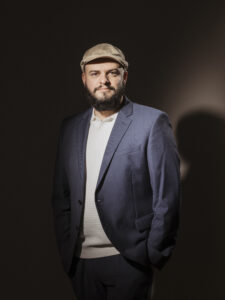 Frederik von Castell (pictured left) has been editor-in-chief of medium magazin since 2024. Prior to that, he was editorial director at “Übermedien,” a fact-checking editor at dpa, a data journalist (including at HR and SWR), and a staff member at the Journalism Seminar at the University of Mainz. As a trainer and adjunct lecturer, he teaches courses on media and data journalism, investigative reporting, fact-checking, and verification. And he believes media journalism is worthwhile when it’s neither focused on stern finger-wagging and quick takedowns nor engaged in self-indulgent navel-gazing through polite conversations within the industry. Image by Iona Dutz
EJO: You’re the editor-in-chief at Medium Magazin; before that, you worked at Übermedien. But you also worked as a data journalist for a long time. Was there a specific moment when you decided to devote yourself entirely to media journalism?
von Castell: That actually happened when I was working in the fact-checking department at dpa. It was a great job. And yet, after half a year, I was determined to move into media journalism. I realised there: I want to do fact-checking, but I want to do it in a way that also addresses the media itself.
I was at DPA during the COVID-19 pandemic. We dealt in particular with misinformation regarding health behaviour or in connection with conspiracy theories. But fact-checking very rarely acknowledged that the media themselves could be part of the problem—for example, by giving conspiracy theorists a platform in the name of balanced reporting. You saw that happen quite often during the pandemic. Whenever an expert suggested a very cautious approach, there was always someone who had to counter that by saying, “We don’t need any of that.” But when that person had absolutely no qualifications, I had a problem with that. I would have liked to criticise that publicly. But that wasn’t really possible because that kind of media journalism role wasn’t part of the DPA fact-checking process.
However, I didn’t want to leave the stage for criticism to those who shout “lying press.” I wanted to offer serious media criticism. So one thing led to another, and I ended up at Übermedien. Since then, I haven’t wanted to do anything other than media journalism.
How would you describe your relationship with criticism, and does it differ from the industry’s relationship with it?
In pieces I address directly to our readers, I always write: Praise feels good, but criticism helps us grow. I’ve never taken a single step forward in my life because people told me how good I was. I’ve only gotten better in the moments when I’ve received criticism or when I’ve sought it out.
I’ve mentored many interns and have always worked with younger people. Of course, you could make it easy for them and just quietly smooth over all their mistakes. But that would be a disservice to them.
For me, criticism isn’t negative at all. But just offering criticism is too easy for me. I’d much rather criticise while simultaneously showing how others do it better. I think that’s how you turn media criticism into media journalism with added value. This includes analysing mistakes just as much as practical learning.
Just criticising and just tearing people down isn’t efficient, because then people shut themselves off. Offering fair criticism, not permanently shaming anyone, setting a cautionary example, but at the same time pointing out a solution—that’s what I find most impressive. That’s also what makes for good media journalism.
At Medium Magazine, you select the “Top 30 Under 30” every year to highlight young talent in journalism. Is the goal here also to focus on the positive?
We want to give the next generation a platform. We try to find 30 different people. Not the 30 “best,” but 30 role models who are as diverse as possible—people who represent a facet of the industry that others may not have seen yet. You can connect with these people and support one another. I’m trying to emphasise this aspect even more.
I often have to address the criticism that we’re selecting the “Top 30 Under 30.” But I can say from my own personal experience that they fulfil an incredibly important role. I became one of the “Top 30” in 2020. If that hadn’t happened, I probably wouldn’t be in journalism today.
At the time, I was working as a freelancer for public broadcasting and had a small position at the university. But that was only temporary. Then the pandemic hit. At public broadcasting, there were more and more tasks for less and less money. Things got really tight. My bank account was in the red. It was clear that I wouldn’t be able to stay in that job much longer. After being selected for the “Top 30,” more people supported me and recognised my value. Above all, other people from outside the field started taking notice of me.
Now I’ve been helping to select the “Top 30” myself for three consecutive years. I call each and every one of them personally once it’s clear they’ve made the list. It’s the best workday of the whole year. And every time I make those 30 calls, there are five people among them who feel the same way I do. In that moment, they realise: “Okay, apparently I do belong here after all.” And I’m also aware that for every five or ten of these people, there are 50 or 100 others out there waiting for that call who never get one. I see that. But every time, I enter the discussion and say: “Otherwise, no one else will do it.” Otherwise, the next generation won’t be supported at all.
I definitely see both sides: On the one hand, it’s great when you can give people a sense of motivation and appreciation. On the other hand, the competitive pressure is high anyway, and many—especially young media professionals—feel like they can’t keep up. So, of course, being left out of such a selection process can be even more demotivating.
I especially want to say this to those who are just starting out: I was in school until I was 26. At 30, I was still working primarily at the university. Data journalism was more of a side gig for me. I went into journalism full-time when I was 31. A year later, I was an editorial director; three years later, an editor-in-chief.
That might sound like I’m bragging, but every single step was just a coincidence. I got lucky every time—I knew someone or was in the right place at the right time. And above all, let’s not kid ourselves: I have few, if any, characteristics that lead to others being discriminated against. As a white, bearded guy with German as my native language and the privilege of a relatively smooth educational path—made possible by my parents—I’ve had it much, much easier in this industry than others. Anyone who tells themselves that’s not part of it is either delusional or lying to themselves.
But no one’s path follows the same pattern. I see so many aspiring journalists, especially those between the ages of 20 and 25, who put an unbelievable amount of pressure on themselves. Every time, I want to tell them: You’re already so good. The only thing you still need is experience. My advice is: Learn early on to work solidly for yourselves, and then you’ll shine. Sometimes you can’t live up to expectations when you move too fast. I was very fortunate to be able to take small steps first and then be ready for the bigger ones.
But I also felt the pressure—we all did. I still feel it, but now I see it more clearly: Shaping the future of journalism should be the responsibility of people my age and older; we mustn’t immediately saddle those just entering the field with that burden. We’re the ones who have to ensure that as many people as possible can bring their full talent to journalism, that the pressure in the industry eases, and that working conditions improve again. That’s not something the next generation has to accomplish on its own.
You mentioned that you realise factors related to discrimination also play a role. To what extent does the magazine take such factors into account when selecting the “Top 30 Under 30”?
First of all, we approach this from a different perspective. We look at how diverse the forms of journalism are. We want to give just as much consideration to classic “run-of-the-mill local journalism” as we do to someone who perhaps only does interactive livestream formats. We’re looking for the most exciting profiles.
Overall, I feel that the selection has automatically become more diverse—especially when it comes to gender. Without consciously aiming for it, we’ve had an abundance of great, young female journalists in recent years. But “diverse” also means other things: We’re now seeing more people who have chosen a path into journalism other than the traditional route through journalism school and an internship. That’s good news. At the same time, I’m very critical of major media brands that advertise only a handful of positions and reserve them for graduates of the top universities.
We don’t consider family background or similar factors in our selection process. The good news is—and here I’m speaking again from the presumably unqualified perspective of a white man in his mid-thirties—that the industry is continuing to evolve in this area as well. At the same time, we recently published a major investigative report by the Kitt Collective. It showed that racist structures are still entrenched in many newsrooms. That cannot be allowed to happen.
The issue of social mobility—or rather, the lack thereof—in journalism was also widely discussed in the context of the study “Classism in Journalism”. The study concluded that social background still plays a significant role in journalism.
The problem is: You have to be able to afford to switch careers. You first have to be able to do journalism on the side. Unfortunately, that hasn’t changed. However, the opportunities to pursue a career in journalism have expanded. I feel it’s now easier to enter journalism through alternative paths.
I try to support this, not only through initiatives like the “Top 30,” but also by collaborating with writers. I’ve never looked at a writer’s resume. I receive the text and talk to the person if I see any shortcomings. If there are a lot of them, we might only work together once. But as a rule, I can tell within ten minutes on the phone whether someone wants to do journalism well and is passionate about it. And honestly, I don’t care at all whether the person comes from the Henri Nannen School or learned it on the side in an online course.
I’d also like to talk about the changes at Medium Magazin. Until March 2026, you were primarily a print magazine; then you repositioned yourselves as an online magazine. How has that changed the way you work?
Instead of producing six issues of the print magazine a year, we now produce four. Here, we place a stronger emphasis on major core topics, while online we aim to deliver magazine content 365 days a year. The two complement each other very well. Before, we often faced the problem of not being able to cover certain topics because the print issue didn’t go to press until six weeks later. By then, the topic was already outdated. Now we don’t let anything slip through the cracks—we get started right away on our digital content.
Of course, this change has meant a whole series of adjustments to our production processes. As an editorial team, we do a lot ourselves and are a very small team. We have to constantly readjust. We try out many things, but we also drop them if they don’t work—for example, if they’re a lot of fun but don’t interest anyone, or simply take too much time.
In short: Things are going well. And we’re not alone out there. Many say that media journalism is on the decline. But in the digital realm, it’s much more present than it was five years ago. Of course, other players have greater reach—there are plenty of far-right content creators, in particular. But they no longer have the space all to themselves. We offer a serious, journalistic perspective so that users can encounter a story from multiple angles as they scroll.
Does your editorial team measure the reach of your articles?
A little bit. But we don’t target a mass audience—we primarily target journalists. If we publish an article on image rights in photojournalism and only a thousand people see it, we may still have reached the entire target audience for that topic. When we publish a how-to piece on how to handle a press law information letter, my goal isn’t for it to be read by 15,000 people on the first day. The next time a journalist receives a press law information letter, I want them to find our article and understand what it means and what steps to take. If that doesn’t happen until six months later, that’s fine too. What’s important is that the audience knows we can provide this knowledge and this service. The rest will follow. For us, reach only becomes meaningful if you give it time. It makes no sense for us to check the numbers every day. On social media, I prefer organic growth to hitting individual spikes. We’d rather have three or four good posts a week consistently than one that goes viral once a month.
I also think this strategy isn’t bad when it comes to AI. User behaviour is changing: Users aren’t searching for facts on Google; instead, they want the facts delivered as a complete solution to their problem. They ask a question and look for the solution. If your product, like ours, addresses problems and offers practical solutions and service, that’s not such a bad thing for this new world. Unless, of course, AI simply takes the content for itself. There was a similar problem with Google Snippets in the past, for example.
Large online platforms and journalism don’t always get along right away. Medium Magazine is now also on Mastodon, an independent microblogging service that’s considered an alternative to X and is part of the so-called “Fediverse.” What led you there?
Medium Magazine is the second Medium publication I’ve brought into the Fediverse. I did the same thing back then with Übermedien. Maybe that’s part of a romantic hope.
So is it also a statement?
Definitely, among other things. I wouldn’t think it was right for us to ignore those who are trying to shape a free internet. At the same time, it’s a lot of work. We manage a total of six different social media channels: We use four networks the most, which can basically be described as short-form messaging services. These are BlueSky, Threads, X, and Mastodon. Here, we share shorter posts. At first glance, LinkedIn and Instagram don’t seem similar, but they’re very similar in terms of preparation. Here, we share longer captions. This very simple social media strategy is also a result of our limited resources. We put out our content, and whoever follows us sees it. The right target audience is also growing in the Fediverse. That’s why we’re giving it a try.
At the same time, we’ve cut ties with Facebook, for example, because nothing was happening there anymore. Before my time, that was long the most successful platform for *Medium Magazin*. X also seems increasingly irrelevant to our work with each passing month. But there, I still feel even more strongly that I have to keep the flag flying.
The EJO operates with a scholarly focus. Media research and media journalism should really go hand in hand, shouldn’t they? What does your collaboration look like in that regard?
We try to gather and translate as many relevant findings from academia as possible. The art of media journalism lies in communicating media studies without forgetting that journalists are also ordinary consumers. They, too, want to read good stories. There are many people who are both scholars and journalists and can bridge both worlds. Such people are brilliant because they give journalism—and especially media journalism—depth.
But I still find it absurd how often this collaboration falls apart. Unfortunately, it almost always fails because of communication issues. Researchers often expect to be quoted in great detail. That would only work for a very niche audience and, more often than not, would explain far less than some communication scholars believe. As a journalist, it’s very important to me to understand exactly what someone has discovered and what I’m writing down. But then there must also be trust that I’ll translate the content into language accessible to a broader audience. Just as I must always trust my counterpart’s expertise to some extent, I must also be able to expect the same for my work.
What I unfortunately notice far too often is that many people in communication research aren’t actually active in newsrooms themselves—or haven’t been for a very, very long time. As a result, they tend to analyse the media world through the same old long-term studies and questionnaires. In doing so, they fail to see the current issues and problems facing media organisations. I’ve probably been presented with a questionnaire on journalists’ understanding of their roles—based on Weischenberg’s model—at least 50 times in my life. It drives me to despair when the same questions are asked over and over again in an effort to maximise comparability, while reality is completely ignored.
From the perspective of a media journalist: What do you hope for from communication and journalism research?
Get to the bottom of it! Are we, as journalists, contributing to more and more people voting for an extreme party? What are we doing wrong? Seriously: Find out what we’re doing wrong. We need to clarify these questions, and as journalists, we need help from those who study us scientifically. Just answer this question for me once and for all: Does it help the AfD when Tino Chrupalla appears on Caren Miosga’s show, or does it hurt the party? And don’t just survey TV viewers to find out. Find metrics that capture the impact of the snippets from his appearance on his TikTok account. I have the feeling that we’re not solving the core problems with the questions we’re asking right now.
Another topic on which I urgently want more input from media studies is local journalism. What do realistic future scenarios look like, and who will take over that role if necessary? And we mustn’t just think about what comes next. We also have to think about those who, with the decline of local journalism, are losing something they’ve had their whole lives.
I see far too many blind spots here. But perhaps we’re all simply not engaging enough in dialogue with one another, and I’m simply not seeing the opportunities for dialogue, the innovative fields, or the practical guidance. If this resonates with you, please get in touch!
So, for example, would you like to see more practical workshops for newsrooms?
There are many ways to effectively combine research and practice. The Journalism Seminar in Mainz—where I trained and where I worked for my first employer—organises, for example, two academies a year on consumer journalism and financial journalism. I’m one of the speakers at the consumer journalism academy. I explain how to conduct fact-checks and why fact-checks and consumer journalism go hand in hand. So the university offers these continuing education programs where experts and practitioners come together. The Netzwerk Recherche conference in Hamburg is another example of a place where reflection and practice intersect. Everyone there learns an incredible amount.
How do you view the future of media journalism right now?
For a long time, we all complained—I complained a lot, too—that there are fewer and fewer outlets producing media journalism. That’s true. But I believe the big wave of complaining is over. A lot of new things are taking root. Übermedien, for example, is a complete success story. For the first time in many years, I’m also seeing an incredible number of young writers who want to pursue media journalism. The fear of it has finally disappeared. And I stand by this: even if it sometimes feels like a waste of time, the work isn’t in vain. Those who need it will find what’s out there. There will always be an audience for media journalism—as long as there are journalists.
This article, “Praise is good, criticism helps us improve“, was originally published by the European Journalism Observatory on October 23 2026.