

Media leaders from across Africa have adopted a landmark declaration aimed at strengthening press freedom, promoting accountability and responding to the growing influence of digital technologies on journalism.
Meeting in the Zambian capital, on 17-18 March 2026, the delegates to the African Media Councils Conference adopted the Lusaka Declaration on Media Self-Regulation, Accountability, Sustainability and Information Integrity in Africa.
The event brought together media councils, journalists, civil society groups, academics and international partners under the Network of Independent Media Councils in Africa (NIMCA).
At the centre of the declaration is a strong endorsement of independent self-regulation as the preferred model for ensuring media accountability in democratic societies. The communique released after the conference reaffirmed that self-regulation provided a credible mechanism to uphold ethical journalism while protecting editorial independence from political interference.
Participants noted that media councils played a broader role than simply handling complaints. They are increasingly responsible for setting standards, engaging the public and safeguarding the integrity of information in a fast-changing media environment shaped by digital platforms and artificial intelligence.
Rhodes University media studies lecturer, Dr Taryn de Vega, who attended the conference, noted: “Councils are not just there for the media. They exist to serve the public… to ensure that citizens have recourse when ethical standards are breached.”
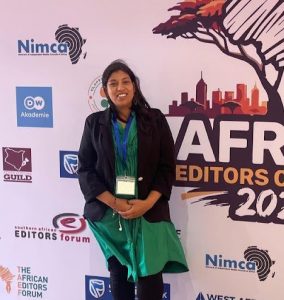
Dr Taryn de Vega
Despite differing national contexts, a strong consensus emerged around the importance of independent, self-regulatory media councils in safeguarding press freedom.
In contrast to statutory bodies—common in parts of North Africa—self-regulatory councils in Southern Africa are seen as crucial for protecting editorial independence and enabling robust public-interest journalism, argued Dr De Vega.
These councils typically operate as multi-stakeholder bodies, comprising journalists, editors and public representatives, and are designed not to control the media but to uphold ethical standards and provide mechanisms for public complaints, she added.
Importantly, participants stressed that media freedom is not solely a right of journalists, but a public right.
The conference took place amid growing concern about threats to media freedom across the continent. Delegates pointed to political pressure, economic challenges, disinformation and attacks on journalists as key risks facing the sector. They also raised concerns about online harassment, particularly targeting women journalists and marginalised groups.
A major focus of the discussions was the impact of digital transformation. The declaration highlights how the media landscape has shifted from traditional newsroom structures to a complex, networked ecosystem where information is produced and shared across borders and platforms.
Artificial intelligence was identified as both an opportunity and a risk. While it offers tools for innovation in journalism, participants warned that it could undermine editorial integrity and public trust if not properly governed. In response, media councils committed to developing African guidelines on AI and journalism ethics, while promoting transparency in AI-assisted content.
Sustainability also emerged as a critical issue. Many media councils operate under financial strain, raising concerns about their long-term independence. The declaration calls for diversified funding models and stronger partnerships to ensure that councils can function without undue influence from governments or commercial interests.
The conference also marked a renewed push for regional cooperation. Delegates committed to strengthening coordination through NIMCA and supporting the establishment of the Southern Africa Press Councils, a platform aimed at enhancing collaboration, sharing best practices and addressing common challenges such as misinformation.
In addition, the declaration emphasises the need for greater public engagement. Participants called for improved access to complaints systems, increased transparency in decision-making, and stronger efforts to raise awareness about the role of media councils.
Promoting media literacy was highlighted as essential to building public trust in journalism.
Looking ahead, delegates agreed to develop mechanisms to monitor the implementation of the declaration and to deepen collaboration with regional organisations such as the African Union and Southern African Development Community.
They stressed that while engagement with governments is necessary, maintaining independence remains critical.
The declaration concludes with a call for solidarity among African media institutions, emphasising that a strong and independent media ecosystem is essential for democracy and access to credible information.
Delegates also made commitments to update codes of conduct to address emerging issues such as artificial intelligence, online misinformation and the rise of non-traditional content creators, including influencers and independent digital publishers.
Another key takeaway from the conference was the central role of collaboration.
Participants highlighted the need for partnerships between media institutions, academia, civil society, and, in some cases, the state. While independence from government remains a core principle, pragmatic engagement is often necessary to ensure the viability of media systems in complex political environments, said Dr De Vega.
Academic institutions, in particular, were recognised for their dual role in providing research and thought leadership, as well as contributing to policy development and training, she added.
Featured image by Brett Sayles via Pexels.