
By Enock Sithole
The African Journalism Educators Network (AJEN) used its 2025 annual general meeting (AGM) to reflect on its rapid growth, outline challenges facing journalism training on the continent, and elect a new leadership to steer the organisation through a period of consolidation and expansion.
Founded in 2023, AJEN was established with two ambitious goals: to strengthen democracy by cultivating independent media through robust journalism education, and to elevate the global profile of African journalism.
“This focus on journalism as a craft — on practical skills and industry connections — is part of what sets us apart,” re-elected president, Prof. Franz Krüger, said in his opening remarks. He noted that the organisation has avoided duplicating work done by long-established scholarly networks such as the South African Communications Association (SACOMM) and the East African Communication Association (EACA), while still recognising the importance of academic publishing and research for its members.
AJEN’s most visible achievements over the past years have been its in-person roundtable meetings, which have convened journalism educators from across Africa. These gatherings, held previously in Kigali, Nairobi and Johannesburg, most recently reconvened in Accra — a meeting hosted by the University of Media, Arts and Communication (UniMAC).
Prof Krüger described the roundtables as “invaluable in building a community of practitioners,” stressing that exchanges at these events often spark collaborations and conversations that continue long after the meetings end.
However, he acknowledged a major obstacle in the high cost of travel for African academics. With the next meeting tentatively scheduled for Mauritius in September 2026, Prof Krüger suggested that AJEN adopts a hybrid format to enable greater virtual participation and reducing the financial burden on members.
The roundtable has also become a magnet for allied organisations, Krüger added, with other groups increasingly scheduling events alongside AJEN’s meetings — an indication of the network’s rising influence.
AJEN has taken steps to establish itself globally. It is now part of the World Journalism Education Council and has formed a content-sharing partnership with the European Journalism Observatory. The network has also collaborated on journalism teaching initiatives and continues to explore new international linkages.
One area where the organisation has had an unexpected but welcome impact is in stimulating the formation of country-level journalism educator networks. Ethiopia and Nigeria already had similar structures, but newer national bodies have been formed following discussions at AJEN roundtables. Strengthening these country chapters is now a priority, said the AJEN president.
Administrative hurdles and new Initiatives
Despite its growing profile, AJEN continues to grapple with organisational and administrative challenges. Most notably, the network still does not have a functioning bank account after a prolonged but unsuccessful attempt to open one through ABSA bank. As a result, all activities, including travel and meeting expenses, have been paid directly by partner organisations. The board confirmed that AJEN will restart the process with another bank in 2026.
Secretary-General, Prof Sisanda Nkoala, presented the annual report, describing 2025 as a year of “intensive strategic and administrative engagements”. The board met monthly, oversaw the Accra meeting, organised a digital campus media conference, submitted an academic panel to the World Journalism Educators Congress and worked on organisational documents such as a new gender policy.
The campus media conference, led by board member Dr Basil Hamusokwe, attracted significant interest and will form the basis of a special journal issue. It also led to the creation of an AJEN interest group dedicated to campus media.
One of AJEN’s most popular initiatives has been its monthly newsletter, Ajenda, featuring opportunities, organisational updates and the well-liked “Meet Your Colleague” profile series. Board-produced video briefs exploring the humorous side of journalism teaching — circulated on LinkedIn — have also helped boost AJEN’s visibility.
A gender policy, approved earlier this year, aims to promote inclusivity, respect and equity across all AJEN activities. In addition, multiple interest groups have been formed in areas such as research, curriculum development, campus media, gender, and professional development.
Vice-president, Dr Nancy Booker, reported that the professional development group is working to bridge the long-criticised divide between academia and the newsroom. The group is planning webinars, industry-led sessions and possible exchanges that would allow educators to spend time inside newsrooms.
“We need to break the silo between practice and academia,” she said, calling for stronger newsroom–university collaboration across Africa.
Constitutional amendment and leadership elections
Members unanimously agree to amend the constitution to allow up to three outgoing board members to serve up to a third term when necessary, ensuring institutional continuity.
Elections for a new board followed, with the members of the previous board elected as follows:
- President: Prof Franz Krüger
- Vice-President: Prof Dr Nancy Booker
- Secretary-General: Prof Sisanda Nkoala
- Treasurer: Christina Chan-Meetoo
Additional board members were elected as follows:
- Dr Basil Hamusokwe
- Prof Margaret Jjuuko
- Prof Modestus Fosu
- Pheladi Sethusa
The board will consider co-opting additional members to strengthen regional diversity, Prof Krüger told the AGM.
Ending the meeting, Krüger urged members to stay engaged, emphasising that AJEN remains a voluntary organisation driven by the commitment of its educators. “We look forward to building this network for the benefit of journalism education and the journalistic media on the continent,” he said.
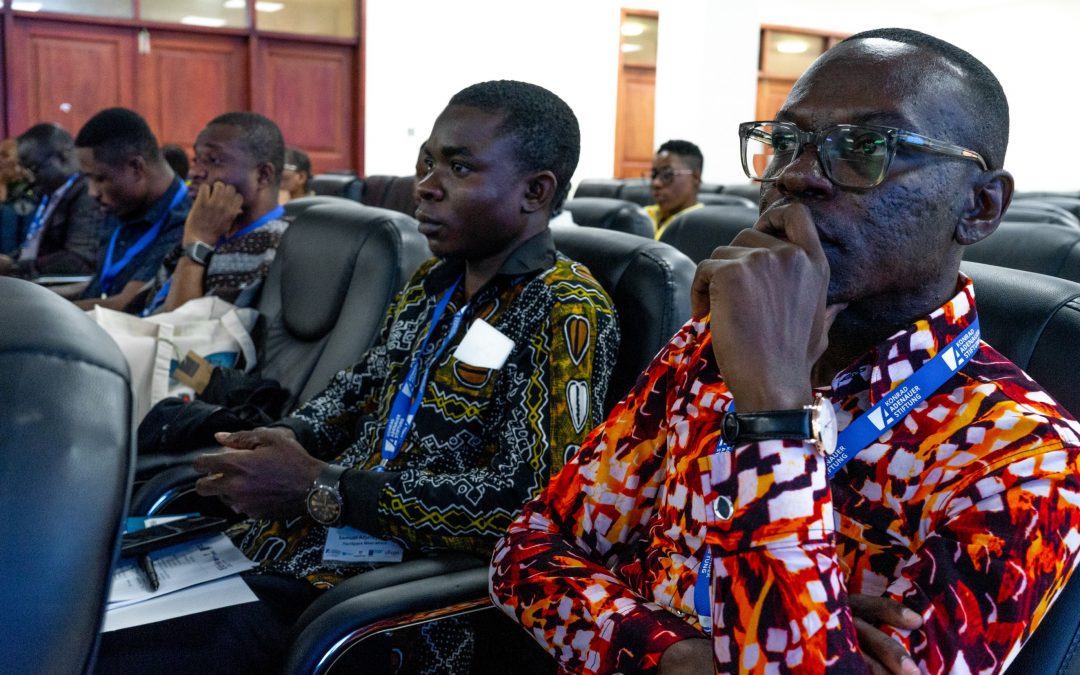
Image from the 2025 African Journalism Education Network annual round table. Accra, Ghana.