
News
Ajen publishes a monthly newsletter, called AJENda, to keep colleagues aware of changes to the journalism landscape in Africa from an academic, research and professional point of view.

New Publications in April 2026
Explore our latest selection of publications unpacking how communication drives social change, how AI is reshaping societies and ethical decision-making, and how digital platforms are transforming democracy and public life. Observe exciting perspectives on how knowledge, technology and storytelling continue to redefine media landscapes globally and across Africa.
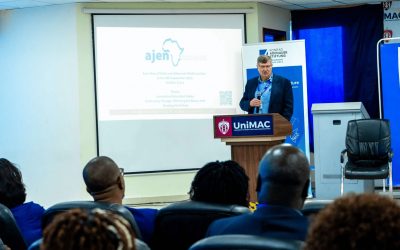
Ajen round table 2026
The 2026 edition of the annual round table meeting of the African Journalism Education Network (Ajen) comes to Mauritius, from 12 – 14 August 2026. And you’re invited! The event is open to Ajen members and non-members, offering opportunities to hear from industry leaders and journalism educators, to discuss important issues of common concern, to learn and network.
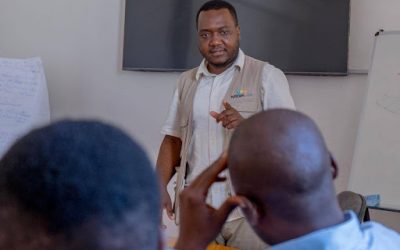
NGOs step in to train climate journalists as formal education training gaps persist
Non-governmental organisations (NGO) are increasingly stepping in to train journalists in climate change reporting across Africa, filling a gap left by universities and journalism schools that have yet to systematically incorporate the subject into their curricula. In Mozambique, Mídia Lab’s senior media expert, Yuri Nota, says civil society organisations are playing a growing role in equipping reporters with the skills needed to cover one of the continent’s most pressing challenges.
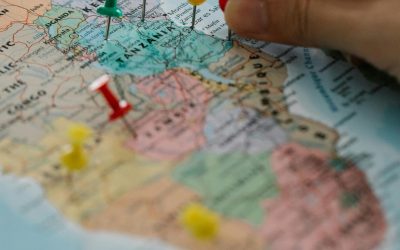
New Power Centers in African Journalism
A new research project at the Erich Brost Institute for International Journalism is examining how BRICS+ actors influence professional standards and editorial practices. China and Russia are systematically expanding their media presence in Africa, while Western funding programs are on the decline. How do journalists navigate between geopolitical interests and professional autonomy? The international research project focuses on one of the central questions in current journalism research: How are geopolitical power shifts altering journalistic practice and professional standards in Sub-Saharan Africa?
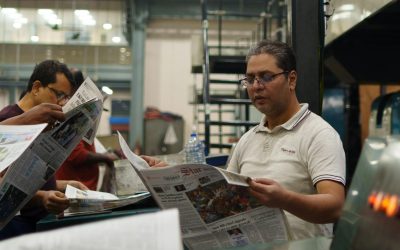
Disinformation Isn’t Just Noise, It’s a Global Strategic Weapon
Disinformation is not a buzzword. It is a systemic crisis undermining truth and destabilizing societies across Africa and around the world. By design, disinformation deliberately spreads falsehoods to deceive populations, manipulate behaviour and reshape political outcomes. It is not accidental misinformation; it is purposeful, strategic and increasingly influential. In an era where digital screens are the dominant public square, the flood of engineered falsehoods threatens democracy, public health, economic stability and social cohesion. This danger is not abstract; it is measurable, pervasive and growing. If Africa and the global community fail to confront the strategic weaponization of disinformation with urgency and coordination, the consequences will be dire and enduring.
Training on environmental and climate change journalism takes off in French-speaking Indian Ocean nations
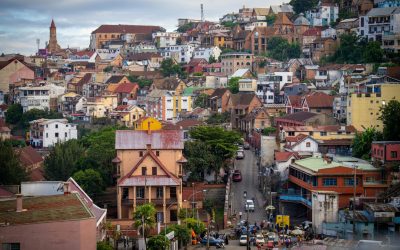
A new training initiative targeting French-speaking countries in the Indian Ocean is seeking to reshape how environmental and climate change stories are reported, moving beyond reactive coverage towards deeper, more analytical journalism. The programme, coordinated by the University of Mauritius with support from UNESCO, brings together working journalists from Madagascar, Comoros, Seychelles, Mauritius, and Djibouti. It also includes participants from Rodrigues Island, as well as a small number of journalism students and environmental NGO practitioners.

African media councils adopt Lusaka Declaration to bolster press freedom
Media leaders from across Africa have adopted a landmark declaration aimed at strengthening press freedom, promoting accountability and responding to the growing influence of digital technologies on journalism. Meeting in the Zambian capital, on 17-18 March 2026, the delegates to the African Media Councils Conference adopted the Lusaka Declaration on Media Self-Regulation, Accountability, Sustainability and Information Integrity in Africa. The event brought together media councils, journalists, civil society groups, academics and international partners under the Network of Independent Media Councils in Africa (NIMCA).

Africa Trains Journalists for Newsrooms That No Longer Exist
Africa’s journalism schools do not have a talent problem. They have a reality problem. Across the continent, too many faculties are still preparing students for a newsroom that has already vanished: a world of cleanly separated print, radio and television tracks; predictable production cycles; and a professional hierarchy built around legacy media institutions that no longer dominate the way they once did. But the global media economy of 2026 no longer recruits on those terms. It increasingly rewards graduates who can move across platforms, work comfortably with digital tools, interpret and visualize data, understand audience behaviour, think entrepreneurially and use artificial intelligence responsibly. Too many African journalism graduates, by contrast, still leave university with theory-heavy degrees, thin portfolios, weak practical exposure and limited confidence in the tools that now shape reporting, distribution, verification and monetization. That is no longer an academic inconvenience. It is a labour-market disadvantage, and it is quietly excluding thousands of capable young Africans from the most competitive corners of the global media and communications economy.

African investigative journalism conference heads to Kenya for first time in 22 years
The African Investigative Journalism Conference, the continent’s largest gathering of journalists, will this year be held outside South Africa for the first time since its inception more than two decades ago. The 22nd edition of the conference will take place at the Aga Khan University’s Graduate School of Media and Communications, in Nairobi, Kenya, from 10 to 12 November 2026, marking a historic shift for the annual event that has traditionally been hosted in Johannesburg by the Wits Centre for Journalism.

Zimbabwe Positions Journalism at the Centre of AI-Driven Development
Zimbabwe’s first National Research Summit on AI and Journalism Education looked at how artificial intelligence is transforming newsrooms and journalism training. Organised by ZIJEN with support from the Fojo Media Institute, the summit highlighted AI’s potential for data-driven reporting and newsroom efficiency, while stressing ethics, human judgment, and African perspectives.
CoMMPASS Conference: E-learning offers opportunities for African journalism education
The EU-funded CoMMPASS project wrapped up its three-year run with a final conference in Uganda, highlighting how e-learning can transform journalism education in Africa. Speakers emphasised bridging the gap between journalism practice and academia, promoting African perspectives, and using digital platforms for cross-border collaboration.

In the classroom and on the frontline: African universities redefine ‘excellence in journalism education’
“Journalism Education in Africa: A Review of Excellence in Practice in 10 Countries” looks at how journalism schools across Africa are redefining excellence in a fast-changing media landscape. The research by Alan Finlay, Anthea Garman and Pheladi Sethusa reviews programmes in 10 countries, highlighting efforts to balance theory with practical newsroom training while navigating resource gaps and uneven industry partnerships.

Fossil Free South Africa launches climate journalism fellowship to tackle reporting gap
Climate advocacy group, Fossil Free South Africa, has launched the Climate Media Lab fellowship to boost reporting on Climate Change in South Africa. The programme will support 20 journalists and digital storytellers with training, expert guidance and resources to help them add climate context to everyday stories.

EACA 2026 conference to reimagine communication in Africa
The East African Communication Association (EACA) will host its 16th conference in Kenya, with organisers promising a broad, cross-cutting conversation on media innovation, peace journalism, digital inequality and policy impact. Conference coordinator Dr Gladys Muasya discusses the event’s push to broaden communication scholarship beyond journalism, addressing issues from AI to conflict prevention.

Humans over algorithms: Wits Centre for Journalism to host SACOMM 2026
As the digital divide shifts from access to agency, the upcoming South African Communications Association (SACOMM) 2026 conference is set to tackle the rise of “techno-feudalism” and its impact on the Global South.