
By Ladislaus Ludescher
The marginalization of Africa in the mainstream media is overwhelming and consistent. Only a minimal proportion of available airtime or print space is devoted to African issues. Even fundamental events in Africa, such as “the deadliest war of the 21st century” (Tigray) and what is currently “the world’s largest and most devastating humanitarian crisis” (in Sudan), are largely marginalized or even completely ignored. Reporting on Africa is not only marginal, but still appears to be dominated by so-called K-issues (wars, crises, catastrophes). When Africa is reported on, which is rare, the coverage is usually negative.
This article is a heavily abridged advance publication of an essay in an anthology on Africa edited by Hans Peter Hahn, which will be published in the coming months.
- The quantity of reporting on Africa
Africa’s marginalization in the media is comprehensive. Research has repeatedly documented this finding in numerous studies and observations. Fabian Sickenberger, who spoke in this context of a “comprehensive agenda cutting” (p. 203) affecting large parts of the continent, pointed out that only about 3.7 percent of the 1,685 Tagesschau reports he evaluated dealt “primarily or secondarily with African states or people” (p. 206). A study published by Jürgen Wilke, Christine Heimprecht, and Akiba Cohen, which evaluated the reporting of 17 countries in 2008, came to similar conclusions and also calculated that only 3 percent of reports were about Africa.
The findings on marginal reporting on Africa are fully confirmed in this article, which is also based on the results of a long-term study by the author and numerous follow-up analyses on the media neglect of the Global South. It should be noted that Africa’s marginalization has even increased in the wake of recent developments (the coronavirus pandemic of 2020–2022, the war in Ukraine since 2022, and the war in Gaza since 2023). In 2024, only a fraction of the reports in the German-language news program with the highest reach, the main edition of the Tagesschau, touched on countries in the Global South (Fig. 1). With a few exceptions, African countries were almost completely absent from the Tagesschau.

Fig. 1 Number of reports in which the respective countries (or political entities) were mentioned in the Tagesschau in 2024
A long-term view of the geographical orientation of the reports in the Tagesschau between 2007 and 2024 shows that coverage of Africa during this period was not only marginal, but consistently marginal (Fig. 2).

Fig. 2 Number of reports in which the respective countries (or political entities) were mentioned in the Tagesschau news program between 2007 and 2024
Overall, the leading German-language news programs (the German and Swiss Tagesschau and the Austrian Zeit im Bild (ZIB) 1) on average only about 10 percent of their broadcasting time to the Global South, even though about 85 percent of the world’s population lives there (classification of Global North/Global South according to the United Nations Conference on Trade and Development (UNCTAD)).
The most recent example of disinterest in the African continent is the media coverage during the 2025 German federal election. An analysis of twelve election broadcasts showed that almost 90 percent of the total airtime was devoted to domestic issues. The Global North accounted for about 9.5 percent of the airtime, while the entire Global South accounted for only 0.75 percent. The thematic focus of the programs was on the migration debate and, in terms of foreign policy, on the war in Ukraine. Africa was not discussed, and even the war in Gaza was almost completely ignored.
The economic powerhouse China and the countries of the so-called MENA (Middle East & North Africa) region, which also includes the North African states, are a certain exception to the media’s lack of interest in the Global South. Interest in the MENA region is mainly due to the wars there involving countries of the Global North (Afghanistan, Iraq, Syria, Libya, Gaza). Sub-Saharan Africa, on the other hand, like Latin America and South Asia, is one of the blind spots of media coverage.
This is particularly evident in a direct comparison of the number of reports in which countries of the Global North and sub-Saharan Africa played a role (Fig. 3).
 Fig. 3 Number of reports in the Tagesschau news program in 2007-2024 in which the respective countries were mentioned
Between 2007 and 2024, over 50,000 reports (excluding sports and weather) were broadcast on the main edition of the Tagesschau. The US featured in almost 10,000 of these reports, or around one fifth. This was followed by countries such as Russia, France, the United Kingdom, and Ukraine, with several thousand reports mentioning these countries. In contrast, Africa’s most populous country, Nigeria, with almost 230 million inhabitants (as of 2024, according to the United Nations Population Fund, UNFPA), was mentioned in only 174 reports. Other populous countries such as Ethiopia (almost 130 million people) and the Democratic Republic of Congo (around 105 million inhabitants) only received 122 and 83 reports respectively. The neglect of countries such as Tanzania (21 reports), Angola (16) and Madagascar (10) is particularly striking. Zambia was mentioned in only one report in 18 years.
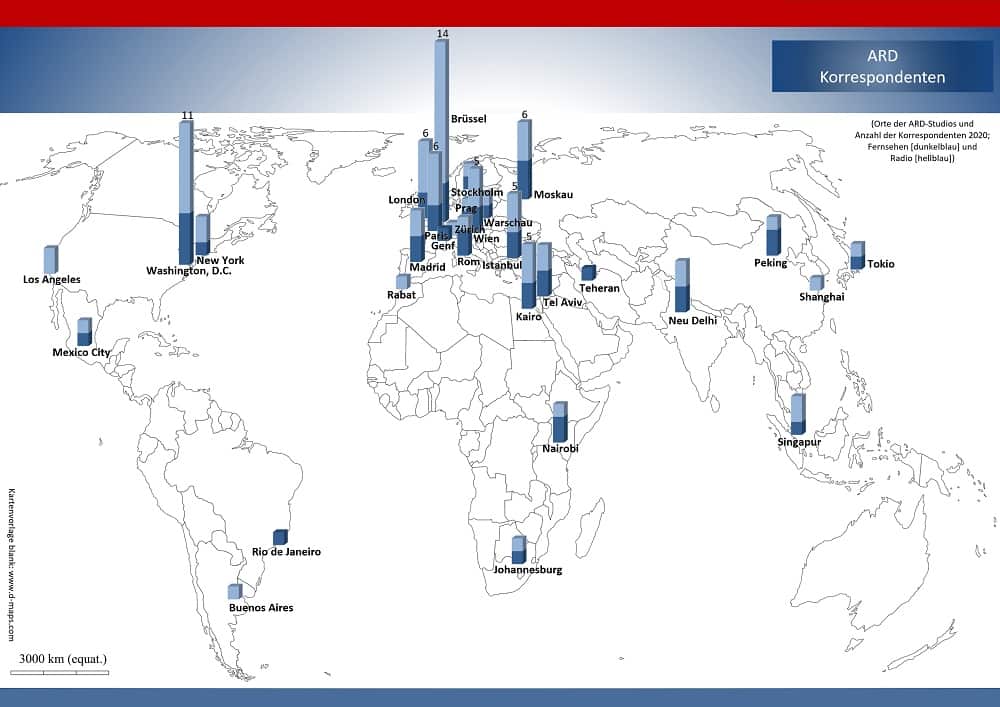
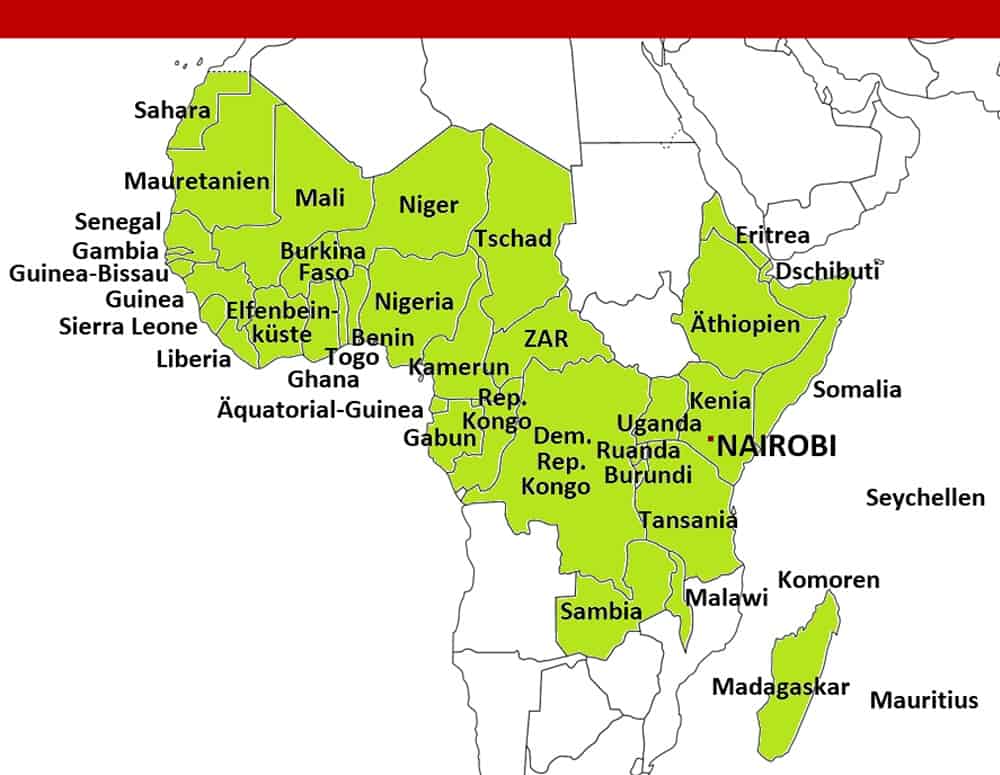
The geographical focus of the Tagesschau‘s reporting largely coincides with the ARD’s network of correspondents (2020), which also highlights the prioritization of news from the Global North over the Global South (and Sub-Saharan Africa in particular). While in 2020, two correspondents from two countries (the Czech Republic and Slovakia) with a combined population of around 16 million reported from the ARD television studio in Prague, the ARD television studio in Nairobi (Kenya) also consisted of two people, who were responsible for 38 African countries with a total population of approximately 870 million (the studio in Nairobi now consists of three correspondents reporting from 33 countries). 870 million inhabitants (the studio in Nairobi now has three correspondents reporting from 33 countries). To this day, the reporting area of the studio in Nairobi also includes Dakar, the capital of Senegal, which is over 6,000 km away. This is equivalent to someone in Brussels reporting on Washington, D.C. With such a geographically unbalanced distribution of correspondents, an overwhelming media overrepresentation and dominance of the Global North is virtually inevitable.
- The example of wars marginalised and ignored by the media

Fig. 4 Extent of reporting on wars and military conflicts in the Tagesschau news program in the years indicated (and for comparison: broadcasting time for sports and soccer)
The media’s neglect of Africa is particularly evident in the varying amount of coverage given to wars (Fig. 4).
Among the military conflicts that have been almost completely ignored by the media is the civil war in the northern Ethiopian region of Tigray in 2020-2022, in which Eritrea was also involved and which, with up to 600,000 deaths, is considered the deadliest war of the 21st century. At least 120,000 women were raped during the war. Amnesty International pointed to serious human rights violations such as crimes against humanity and ethnic cleansing, and criticized the international community’s lack of interest. While the Tagesschau news program reported on the war in Ukraine for around 86,115 seconds in 2022 alone (not including reports on the war’s impact on Germany and the EU, for example in the energy sector), it devoted only 940 seconds to the civil war in Tigray in the three years from 2020 to 2022.
The civil war in Sudan, where the UNHCR warned of a “dire humanitarian crisis of epic proportions,” also met with little interest. UNICEF Executive Director Catherine Russell described the situation in the country in March 2025 before the World Security Council as “the largest and most devastating humanitarian crisis in the world” (“Sudan is now the largest and the most devastating humanitarian crisis in the world”). Back in April 2024, Welthungerhilfe noted: “Sudan is now the country with the most displaced people in the world, half of whom are children. Almost 18 million people are suffering from acute food insecurity.” In contrast, the German news program Tagesschau devoted only 1,365 seconds of airtime to Sudan in 2023 and even reduced its coverage to just 640 seconds in 2024, contrary to the escalation of the devastating humanitarian situation. However, the media’s lack of interest in military conflicts not involving the Global North is not limited to Africa. For example, the desperate security and humanitarian situation on the Caribbean island of Haiti and the civil wars in Myanmar and Yemen were almost completely ignored.

Fig. 5 Number of reports in the Tagesschau news program in 2007-2024 in which the respective countries were mentioned
The number of news reports on conflict regions and countries in Africa, such as Sudan, Ethiopia, and the eastern Democratic Republic of Congo, where, according to UNICEF spokesperson James Elder, a child is raped every half hour, pales in comparison to the extent of reporting on Ukraine, which has been one of the core countries of media attention since 2014 and again since 2022 (Fig. 5). The only coverage comparable to that of the war in Ukraine in 2023 and 2024 was that of the Gaza war (Middle East conflict), and it seems obvious to assume that the high level of media interest in this conflict is due to Israel’s involvement. It is telling that the amount of coverage of all the wars and violent conflicts mentioned in the Global South without the involvement of countries in the Global North (i.e., in Yemen, Haiti, Myanmar, Tigray, and Sudan) in the years 2020-2024 did not even amount to a third of the airtime devoted to sports in the Tagesschau alone in 2024.
- On the quality of reporting on Africa
There are 54 countries in Africa, around 3,000 ethnic groups and, according to estimates, possibly just as many languages. Fabian Sickenberger aptly noted that the defining characteristic of the continent is “not equality, but diversity” (p. 9). Sickenberger referred to the pointed statement by political scientist and Africa expert Rainer Tetzlaff, who stated: “Africa only exists in the plural.” (p. 66)
In contrast, it must be noted that the image of Africa’s socio-political and cultural complexity and multidimensionality portrayed in the media hardly does it justice. On the contrary, numerous images of Africa conveyed in the media are one-dimensional and make no effort to present a differentiated picture. Johanna Mack also drew attention to the criticism that reporting on Africa is shaped by a foreign perception and that “people often talk about Africa from the outside.”
Research has also repeatedly pointed out that many images of Africa conveyed by the media are not only stereotypical but also negative. In the past, Africa was often described as a “continent of sorrow” and “starvation,” and in many portrayals, an improvement in the situation seemed virtually impossible.
However, recent research, such as that by Toussaint Nothias, has emphasized that numerous images of negative perceptions and representations of Africa, some of which have been handed down in research, do not reflect the full scope of reporting. The “Afro-pessimism” of many articles is contrasted with positive and motivating descriptions of Africa as a continent of new beginnings and opportunities, associated with the slogan “Africa rising.” This is undoubtedly true, but it must be noted that, especially in traditional media, where Africa and the Global South as a whole are given very little airtime, the so-called K-topics (wars, crises, diseases, disasters, conflicts, corruption, and crime) play a very large role. Fabian Sickenberger pointed out that almost two-thirds (62.2 percent) of the Tagesschau reports he examined were dominated by so-called K-topics and stated: “The negative focus [is] an omnipresent feature of Tagesschau’s image of Africa.” (p. 197) Sickenberger noted that “a high news threshold […] is easier to overcome with K-topics than with reports on positive or neutral events” (p. 279). Africa expert Martin Sturmer also pointedly stated: “Africa is only of interest in the event of a disaster” (p. 22), and journalist and Africanist Lutz Mükke warned of a “dramatization trap.”
When little airtime is allocated to a geographical area such as Africa, it is almost exclusively used for negative topics. It is, of course, important to report on negative events such as crises, wars, and disasters. These have also been addressed in this article, on the one hand because they are fundamental events with far-reaching human and socio-political dimensions, and on the other hand because they illustrate in a very concise manner the differences in media coverage depending on the geographical location of the event (Global North vs. Global South).
Real problems and grievances should never be downplayed or glossed over, but it is important to repeatedly cite positive examples in order to counteract a potential tendency among media consumers to fatalize and turn away in the face of exclusively negative reporting. However, differentiated and constructive “can-do” reporting that also conveys success stories requires sufficient coverage of Africa and the Global South in general. Only if the media take the time to report not only on disasters and negative events, which undoubtedly exist in large numbers, but also on positive developments and events, which also exist, can the danger of one-sidedness and defeatism be averted. An exclusively negative portrayal that leaves no room for constructive and multi-perspective reporting should be avoided. However, this requires sufficient coverage of Africa and the Global South in general.
Outlook
In print media, the taz and tageszeitung newspapers and the ARTE Journal news program could serve as benchmarks for more differentiated and quantitatively more comprehensive reporting on Africa. In the studies, both media formats showed well above-average coverage of the Global South within their respective genres and top the corresponding lists. It is characteristic of both formats that they have made African events (including those in sub-Saharan Africa) top issues and have taken the time to report on positive examples as well. However, compared to the leading media outlets, both formats reach only a fraction of their viewers or readers.
The editorial teams of so-called leading media outlets might be surprised at how open-minded a not-to-be-underestimated audience would potentially react to more coverage of neglected regions – interest and empathy should not stop at national borders. However, generating interest in a topic requires extensive and, above all, consistent reporting, because interest in a topic presupposes some form of prior engagement with it. Interest and the desire to engage more closely with a topic can only arise if it is reported on and topics and geographical areas are not ignored. It is to be hoped that so-called leading media outlets will also be willing to give the countries and people of the African continent – and of the Global South in general – the attention they deserve in the form of airtime and editorial space.
This article, “Pushed to the margins: The marginalization of Africa in the media“, was originally published by the European Journalism Observatory on 31 May 2025