
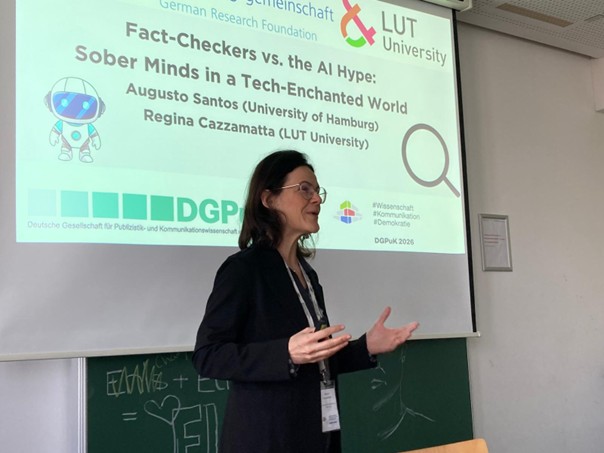
Prof. Regina Cazzamatta (LUT University) at the conference in Dortmund. Image by Susanne Fengler.
By Susanne Fengler
Can a machine verify the truth? As generative AI becomes increasingly powerful, fact-checkers face a fundamental question: How much responsibility can be delegated to algorithms—and where must clear boundaries be drawn?
It was precisely this tension that shaped Panel 22, “Fact-Checking, Transnational Practices, and Normative Orientations,” at the 71st Annual Conference of the German Society for Journalism and Communication Studies (DGPuK) at TU Dortmund University, held under the motto “#Science #Communication #Democracy.” During the panel, international researchers—Regina Cazzamatta from LUT University, Augusto Santos from the University of Erfurt, and Katrin Wallner, Matthias Karmasin, and Larissa Krainer from the University of Klagenfurt—discussed how fact-checking is changing in the context of AI, global networks, and normative standards. The presentations examined fact-checking from various perspectives—ranging from AI applications and transnational dynamics to normative and organizational structures.
The focus was on current research into how fact-checkers integrate generative AI into their work processes—and where they deliberately choose not to.
AI Throughout the Entire Verification Process
One of the projects presented analyzes the use of AI across four phases of fact-checking: monitoring, research, production, and distribution.
It reveals that AI is already being used in all phases to increase efficiency. In monitoring, it assists through the automated detection of claims, or the transcription of public communications and translations. In research, AI summarizes extensive documents and assists with verification, and in production, it is helpful for creating summaries and adapting content for various platforms. AI is also useful in distribution by ensuring the targeted delivery of corrections to previously exposed users. Especially for repetitive and data-intensive tasks, AI is perceived as a significant relief.
Between Fascination and Skepticism
Theoretically, this development is described in the panel as a tension between “enchantment” and “disenchantment.” While AI initially appears to be a promising innovation, practitioners significantly temper this impression in their day-to-day work.
In addition to efficiency gains, problems are emphasized above all:
- Tools for detecting AI-generated content are considered unreliable
- Probability statements (“60–70% AI-generated”) are difficult to communicate
- Technical and financial requirements complicate implementation
This ambivalence shapes the practical handling of the new technologies.
A Clear Boundary: Human Responsibility
A key finding: Fact-checkers refuse to view AI as an actor acting independently. Instead, it is consistently classified as a supporting tool. The interviews particularly highlighted the necessity of human responsibility for all content. The great importance of transparency in dealing with AI is also emphasized. This includes a reflective approach to bias and the program’s training data. In this way, fact-checkers also defend their professional authority in the face of technological developments.
Institutional Rules Reflect Practice
The study also compares individual perspectives with organizational guidelines from 18 fact-checking organizations. The result: There is no fundamental discrepancy between practice and institutional guidelines.
The guidelines also emphasize the importance of human oversight and accountability, as well as the importance of transparent AI use. They address ethical issues and urge the development and maintenance of awareness regarding the risks of AI use. Furthermore, they often include prohibitions on the automated production of content. Professional standards for dealing with AI thus appear to be stabilizing.
Cautious integration rather than technological upheaval
Overall, the panel presents a nuanced picture: AI is neither rejected nor adopted uncritically. Instead, there is a selective and controlled integration.
Three key findings can be noted:
- AI is used to increase efficiency—but not to automate journalistic decisions.
- Human control remains central to professional identity.
- Normative boundaries for the use of AI have already been clearly defined.
Against the backdrop of the conference, which dealt intensively with the challenges for communication and democracy in the digital transformation, the panel makes it clear: The use of AI in fact-checking is not a radical break—but a negotiated, normatively framed process.
This article, “Fact-checking: Between efficiency and control“, was originally published by the European Journalism Observatory on April 7 2026.