
By Enock Sithole
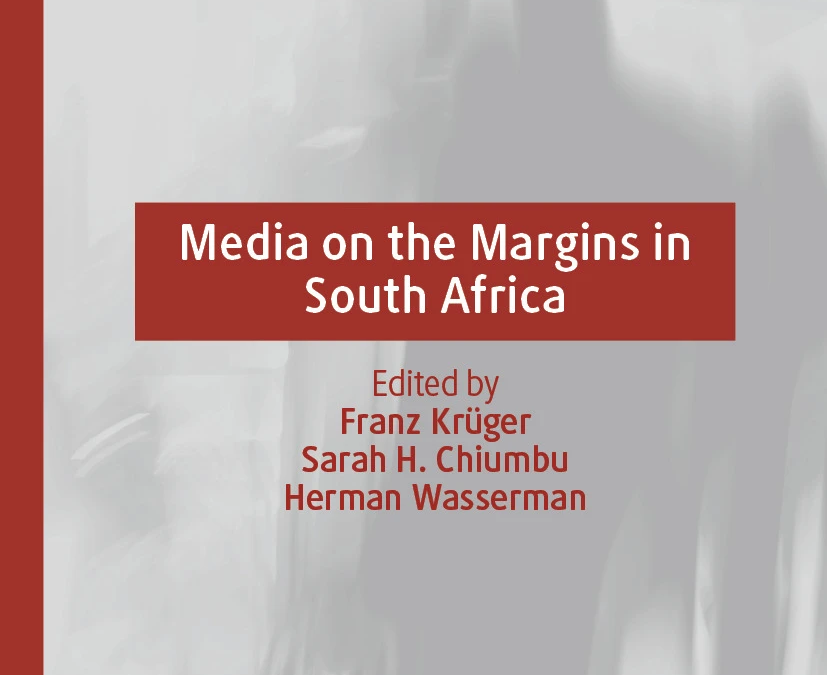
The Media on the Margins in South Africa book arrives at a critical moment for journalism and democratic communication in South Africa and across the African continent.
Edited by Professors Franz Krüger, Sarah H. Chiumbu and Herman Wasserman, the volume offers one of the most comprehensive contemporary examinations of community and local media in post-apartheid South Africa.
Through a blend of theoretical reflection, empirical research and policy analysis, the book foregrounds media institutions and practitioners that are often neglected in mainstream media scholarship.
The central strength of the book lies in its insistence that community and local media are not peripheral to democracy, but foundational to it. While mainstream national media frequently dominate debates about journalism, accountability and digital transformation, this collection redirects attention to community radio stations, local newspapers, community television and emerging online platforms that serve marginalised communities.
The editors demonstrate that these media spaces remain crucial sites for participation, local identity formation and citizen engagement, especially in contexts marked by inequality, poverty and uneven access to information.
Structurally, the book is carefully organised into thematic sections dealing with foundations, policy and economics, content production, people and leadership, and emerging digital challenges. This arrangement gives the volume coherence while allowing contributors to tackle specialised issues from different methodological perspectives.
The interdisciplinary nature of the collection is another major achievement. Contributors draw from media studies, political economy, sociology and journalism studies, producing a nuanced portrait of a sector that is both resilient and vulnerable.
One of the most valuable contributions of the book is its historical and conceptual framing of “media on the margins.” Rather than treating community media merely as smaller or less professional versions of commercial media, the volume argues that these outlets operate according to different social logics.
The chapters challenge simplistic distinctions between “mainstream” and “alternative” media and instead position community media as dynamic institutions shaped by local politics, economic precarity and civic aspirations.
The discussion of policy and sustainability is especially compelling. Several chapters illustrate how post-apartheid reforms created opportunities for previously excluded voices to enter the media landscape, particularly through community broadcasting.
Yet, the book also shows that structural inequalities continue to constrain these gains. Funding instability, advertising dependency, weak infrastructure and regulatory uncertainty remain persistent obstacles.
The analysis of business models in local and community media is particularly insightful because it moves beyond romanticised notions of “community empowerment” to confront the harsh economic realities facing grassroots journalism organisations. Some of these realities have forced the media to broadcast the same kind of content that is carried by their commercial and public counterparts in an effort to attract advertising revenue to survive, argues one chapter.
Equally important is the book’s attention to labour and leadership within community media spaces. Chapters exploring motivation, volunteerism and newsroom leadership reveal how many community journalists operate under difficult conditions with limited resources, minimal job security and inadequate institutional support.
These discussions resonate strongly with wider debates about precarity in African journalism, where journalists frequently navigate political pressure, low pay and digital disruption simultaneously.
The book’s focus on community radio is one of its strongest features. Radio remains the most accessible and influential medium across much of Africa, particularly in rural and working-class communities.
The contributors convincingly show how community radio stations continue to facilitate local dialogue, language diversity and grassroots participation, despite financial and technological constraints.
The exploration of local content production highlights tensions between policy ideals and audience demands, offering a realistic picture of how stations balance public interest obligations with entertainment and commercial pressures.
Another notable strength is the volume’s engagement with contemporary digital challenges. The chapters on digital technologies and disinformation situate community media within broader global transformations affecting journalism.
Rather than assuming digitalisation automatically empowers marginalised voices, the contributors critically examine issues of access, technological inequality and platform dependency.
The analysis of how community journalists respond to misinformation is especially timely in an era where false information increasingly circulates through both social media and political networks.
Academically, the book succeeds in balancing theory and accessibility. While grounded in scholarly research, most chapters remain readable and relevant for practitioners, policymakers and students. This makes the collection valuable not only within universities but also for journalism trainers, civil society organisations and media development agencies working in Africa.
Importantly, the collection challenges prevailing assumptions that local and community media are fading in significance. Instead, it argues that these institutions remain essential democratic infrastructures, particularly in societies characterised by inequality and exclusion.
In doing so, the book makes a persuasive case that the future of journalism in Africa cannot be understood solely through the lens of large commercial newsrooms or global digital platforms.
Overall, Media on the Margins in South Africa is an important and timely scholarly contribution. It combines rigorous research with social relevance and provides an essential reference point for anyone interested in journalism, democracy and community communication in Africa. By centring voices and institutions often overlooked in media scholarship, the book expands understanding of how journalism functions at the grassroots level and why local communication ecosystems remain vital to democratic life. It deserves a wide readership among scholars, journalists, policymakers and students concerned with the future of African media. The book can be accessed here.
Disclaimer: The writer of this overview is one of the contributors to the book.