
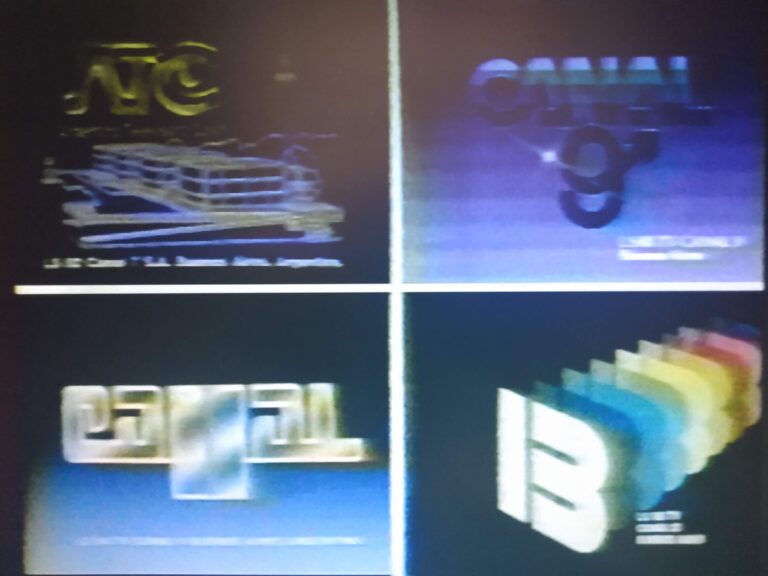
The logos of the four television stations in Buenos Aires in 1981. Source: Personal archive
By Joaquín Sticotti
At a time when the foundations of democracy are being tested worldwide, it is important to understand the role media systems have played in recent authoritarian pasts. The history of television in Argentina reveals an unusual alliance between market logic and state control. It also illustrates how the government used entertainment as a means to create a sense of social normality.
Since the mid-20th century and before the mass proliferation of the internet, television was the most important medium for information and entertainment. Originally conceived as a centralized broadcasting system for multiple recipients without predetermined content, it gradually evolved into the preferred form of transmission for news, sporting events, entertainment programs, and political events. Thus, it also became a stage for political, economic, and aesthetic debates regarding its potential societal uses. Television’s political influence was recognized early on, and its capacity for aesthetic innovation was quickly discussed. Furthermore, a distinct language and a dedicated group of professionals developed around the sector. This granted it a certain degree of autonomy, although dependence on political and economic powers persisted.
Television became a prism through which societies could be understood in their multifaceted dimensions.
Despite its undeniable significance in the 1970s and 1980s, the history of Argentine television during the last dictatorship is not a central topic in academic research. My dissertation, “Argentinian Television Between State and Market: Nationalism, Technology, and Entertainment (1973–1984),” aims to fill this gap. My main hypothesis is that during the period of the strongest state control over television in Argentine history, characteristics associated with its commercial operation persisted—and were even reinforced. Television was used politically for propaganda and psychological manipulation and was subject to censorship. At the same time, ratings continued to determine the success of programs, advertising remained the primary funding mechanism, and television professionals continued to play a central role in programming.
Historical Context: Argentina During the Dictatorship and the Transition to Democracy
Argentina’s recent history is closely linked to the country’s last dictatorship and the subsequent transition to democracy. In 1973, Juan Domingo Perón won the presidential election in Argentina. The Peronist Party returned to power after nearly 20 years of political exile. However, the country was in the midst of a profound phase of political violence fueled by left-wing guerrilla groups and right-wing paramilitary police forces. Perón attempted to restore order but died shortly after taking office. Following his death, his wife, María Estela Martínez de Perón, assumed the presidency. Political violence continued to escalate. In 1975, a severe economic crisis, known as the “Rodrigazo,” also struck the country. Prices rose sharply, which hit the population hard.
In 1976, a coup d’état overthrew the government of María Estela Martínez de Perón. The ensuing dictatorship was led by the three branches of the armed forces, with the army holding the primary power. From the outset, the dictatorship was accused—both within Argentina and internationally—of crimes against humanity, including torture and disappearances. Nevertheless, the regime initially gained popularity: many felt that it had restored order after years of unrest.
After Argentina lost a military conflict with Great Britain over the Falkland Islands in the South Atlantic, the dictatorship began to crumble. Due to internal conflicts and a significant decline in public support, the military was forced to call for democratic elections. Raúl Alfonsín was elected president in October 1983 in these first free elections in ten years, thus ending seven years of military rule.
Argentine Television Before the Dictatorship
Television in Argentina emerged in 1951 during the first term of Juan Domingo Perón. On October 17 of that year, television cameras broadcast the speeches of Perón and his second wife, Eva, before a huge crowd that had gathered in the Plaza de Mayo. The new medium was thus introduced through an event that combined state ritual with a commercial vision. Although its beginnings were deeply rooted in official ceremonies, television quickly developed around entertainment and sports programming and broadcast its first soccer match just a few weeks later.
Between 1955 and 1973, what is often referred to as the golden commercial era of Argentine television began. This period was dominated by broadcasters who shaped the distinctive identities of channels 9, 11, and 13. Television established itself as a private, for-profit industry in which ratings served as the primary measure of success. A specialized professional field—comprising technicians, creative professionals, and celebrities—took shape. At the same time, the armed forces observed the medium with growing interest. For them, television represented not only a form of entertainment but a strategic platform for what they termed “psychological action.”
A decisive turning point occurred between 1973 and 1974. With the return of Peronism, the private broadcasting licenses that had been granted in previous decades expired. An intense public debate began over the future of what was increasingly referred to as “national television.” Intellectuals and segments of the Peronist left denounced the cultural dependence on foreign programs, while business associations defended their role as domestic producers. Following the death of Juan Domingo Perón in July 1974, President María Estela Martínez de Perón nationalized channels 9, 11, and 13.
Under the guise of “public service,” the state assumed direct control over the stations. At the same time, however, their dependence on advertising revenue and competition for viewers was maintained.
This phase of state administration was marked by significant political interference. Prominent figures such as the host and actress Mirtha Legrand and the comedian Tato Bores were removed from television programming. By 1976, the state had established a monopoly over the major television stations in Buenos Aires. This laid the groundwork for the military dictatorship that would soon seize power. It inherited a broadcasting structure already geared toward propaganda and control, while retaining the commercial mechanisms to which the public had grown accustomed.
Censorship, Propaganda, and Entertainment in the Early Years of the Dictatorship (1976–1980)
What followed was an unusual alliance between strict military control and commercial market logic. When the armed forces seized power in 1976, they not only occupied government buildings but also immediately took control of the television stations in Buenos Aires. Remarkably, the regime decided against privatization. Instead, the Army, Navy, and Air Force divided the stations among themselves and managed each as a quasi-autonomous unit competing for ratings and advertising revenue.
Although the dictatorship used television as an instrument of propaganda and censorship—employing “literary advisors” and blacklists—the programming was largely dominated by entertainment. Popular shows such as Videoshow and Mónica, presenta utilized new portable video technologies to present viewers with images of the outside world.
International travel and celebrity culture were highlighted, while the harsh reality of domestic political repression was carefully avoided. The regime relied on this “centrality of entertainment” to maintain a sense of social normality and to finance the television system through commercial sponsors.
The World Cup
The 1978 FIFA World Cup represented the culmination of this strategy. The military established a state-owned company, A78TV, and invested an extraordinary sum—estimated between 70 and 100 million U.S. dollars—exclusively in television infrastructure to build a modern production center and broadcast the tournament to an international audience.
This initiative represented a deliberate attempt to restore Argentina’s international reputation amid mounting accusations of human rights violations. While the “external front” remained largely unimpressed, the “internal front” was swept up in a wave of festive nationalism, amplified by high-quality broadcasts and shared television experiences in movie theaters.
In 1979, the regime sought to propel one of the state-run stations to the top of the ratings. Channel 7 was renamed ATC (Argentina Televisora Color). Carlos Montero, a leading figure in the television industry, was entrusted with overseeing the transformation. Under his leadership, ATC brought prominent stars like Mirtha Legrand on board, launched the modern—albeit ideologically oriented—news program 60 Minutos, and aired major hits such as the telenovela Andrea Celeste. For the first time in its history, the traditionally state-run station became the most-watched channel in the country.
However, the success proved short-lived. By the end of 1979, tensions had reached a critical point between professional television practices—focused on ratings, viewer interests, and creative autonomy—and military ideology, which demanded strict moral and political control. Disputes over the alleged “immorality” of soap operas, combined with internal conflicts within the armed forces, ultimately led to Montero’s resignation.
Crisis of the Dictatorship’s Television Project and Transition to Democracy (1980–1984)
The third part of the study finally analyzes how the military lost control over broadcast frequencies and how television gradually shifted toward a market-oriented model. This phase began in 1980 with a significant technological milestone: the official introduction of color television. The regime expected this innovation to revitalize the medium. However, it coincided with a worsening economic crisis and an overall decline in viewership. To manage this transition, the dictatorship enacted a broadcasting law that established the legal framework for the subsequent return of television stations to private ownership.
The early 1980s were marked by a significant shift in programming: The regime intensified censorship of soap operas by appointing church advisors responsible for monitoring “moral content.” Despite this increasing rigidity, television programming gradually filled with comedy shows that ironically addressed the social tensions of a regime in decline. An unsuccessful attempt to impose state-coordinated, symbolic unity took place in 1981 with the special broadcast Treinta años y una noche. It was a large-scale production covering the three decades since the first television broadcast, in which all four major networks participated. However, the program was widely criticized for its fragmented and incoherent historical narrative.
The Malvinas Conflict
The 1982 war over the Malvinas Islands, also known as the Falkland Islands, marked a dramatic turning point for the credibility of television. The news program 60 Minutos initially broadcast a triumphant narrative that obscured military and diplomatic setbacks. At the same time, the marathon broadcast 24 horas de las Malvinas mobilized the entire television industry for a fundraising campaign in support of the war effort and staged a spectacle of national unity. Later, it was undermined by revelations: the donations had never reached the soldiers. In this climate of crisis, innovative programs began to challenge prevailing conventions and offered more realistic portrayals and parodies of Argentine social reality.
With the restoration of democracy in 1983, television became a key instrument in promoting democratic values and strengthening national cohesion.
This phase also saw the first major step toward reprivatization, when Alejandro Romay regained control of Channel 9 and vigorously advocated for the state’s withdrawal from broadcasting. A milestone for the medium was the broadcast of the documentary Nunca Más in July 1984: It used television’s mass reach to present the harrowing findings of the CONADEP investigation into forced disappearances.
Why is it important to understand the history of television?
My research concludes that the decade between 1973 and 1984 represented a unique historical period. The Argentine state held a monopoly over the major television networks, while the commercial logic of the medium remained at its core. Despite drastic political upheavals—from the third Peronist government through the military dictatorship to the return to democracy—viewership ratings continued to determine the success of programs, and advertising remained the primary funding mechanism.
The study highlights a lasting alliance between businesspeople and television professionals that ensured entertainment-oriented programming remained central, both to maintain social normality and to finance the stations. Furthermore, television served as a powerful tool for fostering national unity, whether during the 1978 World Cup, the Falklands War, or the 1983 democratic elections. Technological milestones, particularly the introduction of color television, were strategically leveraged to promote narratives of nationalism and modernization. Ultimately, the transition to reprivatization shows that the commercial machinery of the mass media was never truly abandoned, despite protracted state interventions.
Understanding the tensions between the state and the market in recent television history is crucial for grasping current debates on media regulation and accountability. As a central cultural institution, television remains crucial for understanding the current transformations in media history.
We must identify continuities in television and media history across dictatorships and democracies: media history follows its own temporality, which does not always coincide with political or economic changes. At a time when authoritarian movements are attacking democracy worldwide, it is crucial to examine the role that media systems have played in the recent authoritarian past.
This article, “What the history of Argentine television teaches us about state, market power and media,” was originally published by the European Journalism Observatory on April 22 2026.