
Commentary by Carol Azungi Dralega
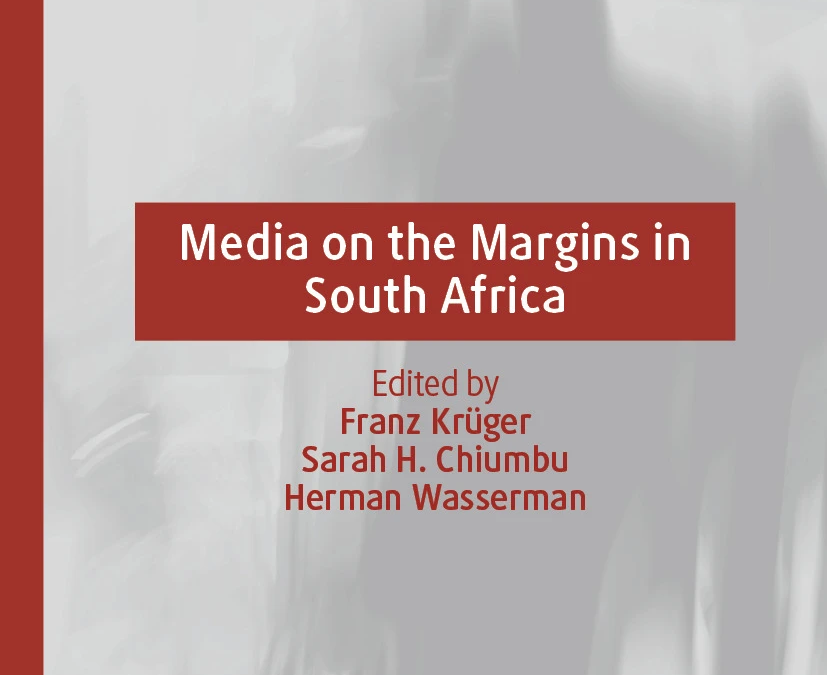
Community media are often discussed in the language of possibility: participation, empowerment, local voice and democratic inclusion. These ideals matter. But Media on the Margins in South Africa, edited by Franz Krüger, Sarah H. Chiumbu and Herman Wasserman, asks us to look more closely at what happens when those ideals meet the material realities of journalism.
The book’s most important intervention is conceptual. Rather than treating local, alternative and community media as sufficiently explanatory categories, the editors propose marginality as a cross-cutting lens. Chapter 2 argues that what matters is not simply what an outlet is called, what platform it uses or whether it is formally commercial or non-profit, but the structural conditions in which it operates. A rural community radio station and an urban faith-based station may both be classified as community media, yet their circumstances can be radically different.
This matters beyond South Africa. For African journalism, it invites a deceptively simple question: when we say “community edia”;, whose community, under what conditions, and with what resources are we talking about?
Marginality is not simply about being small. Chapter 3 provides the empirical backdrop, showing that the geography of media provision continues to reflect broader patterns of wealth inequality. Media outlets serving marginalised areas face different constraints from those operating closer to concentrations of economic and institutional resources.
The political economy chapters make the point harder to ignore. Chapter 5 traces how the South African state helped create and support the local and community media sector through grants, indirect subsidies and, particularly, official advertising. But state support creates a difficult paradox: the state can be both enabler and potential source of dependence and capture.
Chapter 6 takes this further by examining the actual business models of community radio and independent local print. Its evidence points to high levels of precarity, substantial reliance on commercial income and strong state involvement. Crucially, the chapter also shows that marginality is uneven: outlets serving poorer, smaller and more remote communities tend to be worse off, while some outlets serving comparatively wealthier communities of interest perform considerably better.
For editors and media practitioners, this raises a question that is easy to overlook: can we demand the same public-interest journalism from organisations that do not have remotely comparable material conditions?
Being “of the community”; does not resolve questions of power. Chapter 4 offers a particularly useful corrective to romantic notions of community. Examining Grocott’s Mail in Makhanda, Rod Amner and Aphiwe Ngowapi conceptualise local communication as an ecosystem, rather than something contained within a single news organisation. Newspapers, radio, WhatsApp, Facebook, civic organisations, government institutions and informal networks interact within the same communicative environment.
Yet this ecosystem is not necessarily an open public sphere. The authors identify political tensions, historical mistrust and unequal platform use. Even Grocott’s Mail, despite its commitment to civic journalism, faces questions of trust associated with its ownership and journalistic practices. Its reliance on student journalists also creates limitations in local knowledge, language capacity and investigative experience.
This is an important lesson for African newsrooms: proximity does not automatically produce trust, representation or accountability. Local content is not necessarily public-interest content
The book becomes particularly provocative when it turns from institutions to journalism itself. Chapter 8 examines 11 community radio stations and finds that local content averaged 43.4% across programme categories, while the proportion devoted to local news and information averaged only 9.96%. The author connects this gap to resource constraints, regulatory ambiguities and the practical difficulties of producing local content.
Chapter 9 presents a different picture in print. A quantitative analysis of eight community newspapers found that 88.2% of articles were locally focused. Yet much of this coverage consisted of sport, community news and crime. The study also found relatively little coverage of national and international affairs. The tension is worth pausing over. A publication can be highly local without necessarily providing the breadth of information citizens need to understand the forces shaping their lives.
This suggests that the question for community journalism should not simply be how much local content do we produce? but also;What kind of local knowledge are we producing, for whom, and with what democratic consequences?
The people who sustain journalism are part of the story The book also refuses to treat media organisations as machines that operate independently of the people inside them. Chapter 10 explores the motivations and experiences of community media leaders, many of whom operate in a sector characterised by limited financial rewards and significant personal demands.
Chapter 11 goes further through its examination of amaVolontiya—the volunteers who sustain community radio. Volunteerism can provide participation, skills, social capital and opportunities. But in economically insecure environments, volunteering cannot simply be romanticised as civic commitment: it may also be connected to unemployment, skills acquisition and the search for economic opportunity. There is therefore a deeper lesson about resilience. When journalism survives because people are willing to sacrifice, that is evidence of commitment—but it is not necessarily evidence of sustainability.
Digital does not make marginality disappear
The final section brings the argument into the digital era. Chapter 12 compares Hillbrow Radio, an online-only youth-led station, with rural Mbhashe FM, illustrating how digital transformation produces both new possibilities and new inequalities. WhatsApp, Facebook and other platforms can extend participation and reach, but data costs, infrastructure, regulatory gaps and unequal digital capacity remain significant constraints.
Chapter 13 adds another contemporary pressure: disinformation. South African community journalists play an important role in local information environments, but often operate with limited institutional support, training, resources and fact-checking tools. For African editors, this has an uncomfortable implication. Digital journalism is not simply a technological upgrade. The same inequalities that shaped analogue community media can be reproduced through digital systems.
What should African editors take from this? The book does not offer a simple prescription for rescuing community media. Its value lies partly in refusing one. It instead encourages us to ask harder questions:
Are we assessing media organisations according to their labels, or according to the structural conditions in which they operate?
Does “community” describe genuine participation, or merely a geographical market?
Does local content provide citizens with the information necessary to understand and challenge power?
Are we celebrating media resilience when what we are actually witnessing is extraordinary individual sacrifice?
And when digital technologies promise inclusion, who remains unable to participate?
There is also a methodological lesson. Chapter 9, for example, explicitly notes that its newspaper sample excluded KwaZulu-Natal because the available Zulu-language community newspaper presented a language barrier for the researchers. This is not necessarily a flaw in the study—it is a transparent methodological limitation—but it raises a larger question for African journalism research: what does decolonising scholarship require when language determines which media can become data?
Ultimately, Media on the Margins asks us to move beyond celebrating community media simply because they are community media. Their democratic value cannot be assumed; it has to be examined in relation to power, resources, representation, labour, technology and accountability. For African journalism, perhaps that is the book’ss most useful provocation: the margins are not simply places where journalism happens. They are places where the inequalities shaping journalism become especially visible.