
by Augusto Santos
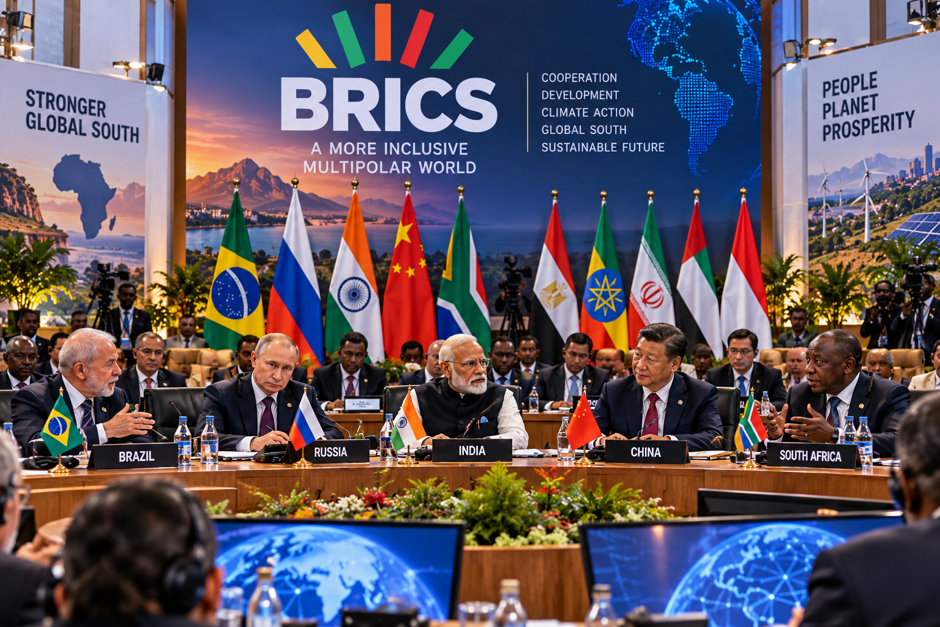
Countries of the Global South are gaining geopolitical influence; the international order is becoming increasingly multipolar. This raises important new questions: Has this shift also changed the way countries communicate with one another? Has the rise of the BRICS bloc led to a greater flow of South-South news?
These questions are at the heart of the study BRICS, Geopolitics, and Synchronisation of Foreign News: Media and the Making of Transnational Public Spheres, which was recently published by Springer. The book is based on the author’s doctoral thesis, which was defended at the University of Erfurt. It examines the limitations and potential of international journalism in bridging geographical distances and fostering transnational public debates amidst profound geopolitical changes and increasingly global challenges.
This debate dates back to the 1980s: at that time, UNESCO became the venue for discussions surrounding the New World Information and Communication Order (NWICO) – a movement through which developing countries challenged the highly unequal global flow of information dominated by Western media. More than four decades later, after the Global South has strengthened its economic and political position through the BRICS bloc (originally comprising Brazil, Russia, India, China and South Africa), a key question remains unanswered: has the new geopolitical multipolarity ushered in a more balanced era of global mass communication?
The study’s findings suggest that the answer is, for the most part, ‘no’. Despite the growing economic and political influence of the BRICS member states, the study concludes that the so-called ‘rise of the rest’ has not been accompanied by the emergence of a robust, transnational public sphere capable of fostering cross-border understanding and solidarity. Instead, traditional Western media outlets such as The New York Times, Reuters and Agence France-Presse continue to dominate the global news flow, even when BRICS countries are reporting on one another. These conclusions are based on a content analysis of around 4,000 news articles published in ten leading newspapers across the five core BRICS member states.
The BRICS group
The BRICS platform was established in 2009 in the midst of the global financial crisis. Originally a group of four nations, it was expanded to include South Africa in 2011, thereby consolidating its role as a challenger to the Western-dominated world order. At its core, the bloc advocates a more balanced distribution of power, as exemplified by the establishment of the New Development Bank in 2015.
More recently, the group underwent a significant and controversial expansion with the inclusion of Egypt, Ethiopia, Iran, the United Arab Emirates and Indonesia. This shift has sparked international concern regarding a possible anti-Western or authoritarian orientation. To focus on the group’s formative, ‘more democratic’ phase, the study analysed news articles from the original five member states published between 2011 and 2019.
The architecture of an uneven flow of information
The media landscapes of these countries are fragmented. Whilst the BRICS states have successfully exported aspects of their popular culture – Brazil, for example, through telenovelas broadcast worldwide, and India through the Bollywood film industry – the international news sector is largely dominated by state-backed media from Moscow and Beijing. Russia and China have taken the lead in the global expansion of news coverage. Both countries have invested billions in media outlets such as RT, Sputnik, Xinhua and CGTN to extend their influence to other regions of the world, such as Africa and Latin America.
However, the potential of these media outlets to foster the exchange of ideas and arguments in the Global South is limited by persistent concerns regarding their credibility. They are often used as instruments of state propaganda or even as vehicles for disinformation. Consequently, journalists in more pluralistic media systems, such as those in Brazil and South Africa, are reluctant to rely on their content.
Coordinated efforts with little impact
This lack of organic synergy is not due to a lack of effort. Since 2015, the BRICS Media Forum has met seven times, with leading figures such as the former president of Xinhua, Congjun Li, urging member media organisations to “speak with one voice” and to join forces to amplify their voices. These summits have given rise to initiatives such as the ‘BRICS International Journalism Online Training Programme’, which attracted participants ranging from India’s The Hindu to South Africa’s SABC. However, the data shows that these efforts have largely come to nothing in terms of media content: the study found that the influence of news from the BRICS countries on general international coverage of the member states is “minimal to non-existent”.
When a Brazilian newspaper reports on an event in India, it is far more likely to quote the London-based news agency Reuters than an agency based in the BRICS countries. China is the only exception. The country relies almost exclusively on its own state news agency, Xinhua.
Blind spots in foreign coverage
Perhaps most strikingly, the media in the BRICS countries themselves pay very little attention to the bloc. The study showed that media in the member states report far less extensively on the BRICS than on the European Union. A likely reason for this is that the BRICS functions more as an informal coordination platform. They are not a supranational organisation that actually implements the policy measures discussed by their heads of state.
This lack of visibility has concrete consequences for the platform’s domestic political legitimacy. In an opinion poll, a staggering 90 per cent of Brazilian respondents did not even know that the BRICS existed at all.
The existing coverage is heavily skewed:
- The US remains the protagonist: just as in Western media, the United States is also the focus of attention in the BRICS’ foreign newsrooms.
- China’s appeal: China is the most frequently covered BRICS member, probably due to its geopolitical and economic significance for the other member states. However, the Chinese media do not reciprocate this attention and provide their domestic audience with relatively little background information on the other members.
- The ‘invisible’ members: India, South Africa and Brazil remain largely ‘blind spots’ in the bloc’s collective consciousness. Despite their role as founding members, there is a marked lack of mutual media coverage amongst these nations, and they continue to play a rather subordinate role in their partner countries’ foreign news coverage.
Multipolarity without connection?
The study paints a picture of a ‘disjointed and fragmented’ process of transnationalisation. Whilst there are occasional moments of synchronised debate, these are generally the result of global crises, such as Russia’s invasion and annexation of Crimea in 2014. They scarcely reflect sustained efforts to help citizens contextualise the Global South.
Ultimately, the study concludes that even in an emerging multipolar world, long-standing asymmetries in foreign reporting persist. For genuine South–South communication to flourish, the bloc needs more than just regular summits; a shift towards a more cosmopolitan and democratic approach to the media is required.
Brazil, India and South Africa face the challenge of establishing competitive, independent media infrastructures to contribute to the global news flow; China and Russia stand at a crossroads. The study concludes that the massive media investments made by these two countries will continue to have only a minor influence on the BRICS partners as long as there are no changes within their respective political systems to enable more credible and less instrumentalised communication. The current fragmentation of national public spheres suggests that, whilst the BRICS states are attempting to move forward economically together, they remain far apart in their perspectives on and reporting of the world.