
By Enock Sithole
The global information environment is coming under increasing pressure from artificial intelligence (AI), misinformation, political interference and the growing power of digital platforms, according to a new international expert survey.
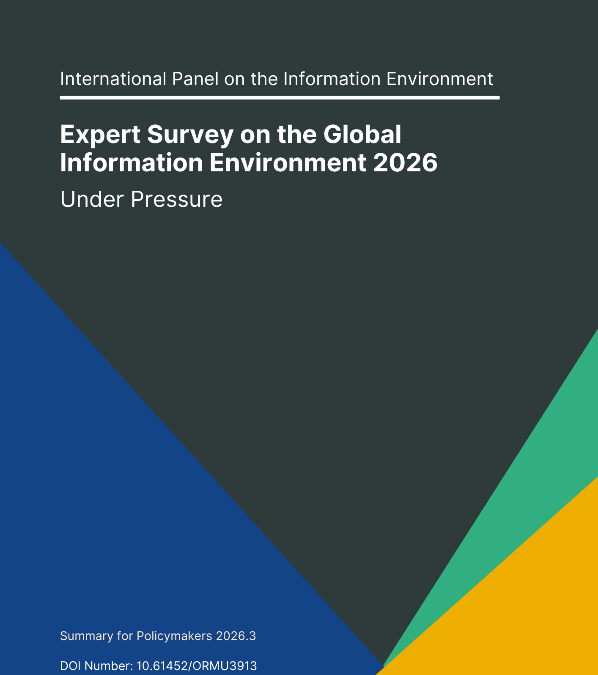
The 2026 Expert Survey on the Global Information Environment, published by the International Panel on the Information Environment (IPIE), found that researchers are increasingly concerned about the ability of people to access diverse and reliable information.
The survey, conducted between May and June 2026, gathered responses from 470 researchers with expertise covering 71 countries. Nearly half of the respondents specialise in developing economies, making it the most geographically balanced survey in the series since the IPIE began conducting the annual study in 2023.
The report identifies four major developments: AI-generated summaries are expected to make information faster to access while reducing visits to news websites and narrowing the diversity of viewpoints; conditions for researching the information environment are deteriorating; experts are particularly concerned about unaccountable platform power; and pessimism about the future of the information environment has reached a record level.
AI summaries threaten traffic to news websites
The growing use of generative AI in search engines is emerging as one of the most significant changes in how people obtain information.
Nearly four in five experts, or 79%, expect AI-generated summaries to help people find answers more quickly. However, 64% believe the technology will reduce visits to news websites, while 58% expect it to narrow the range of viewpoints encountered by users.
The findings point to a potential tension between convenience and the sustainability of journalism.
Rather than requiring users to select from multiple links, AI-powered search can provide a summary directly within search results. While this may improve the speed with which people obtain information, it could also reduce the number of users who visit the original sources.
The IPIE notes that early evidence already suggests users are less likely to click through to sources when AI-generated summaries appear in search results.
For news organisations, this could have important implications because website visits remain an important component of digital advertising, subscriptions, audience development and engagement.
The survey also found that experts remain divided over whether AI summaries will improve the accuracy of information and the conclusions users draw from it.
Platform power remains the biggest concern
Despite the growing debate around generative AI, experts identified another issue as the biggest threat to the global information environment: the lack of accountability of major digital platforms.
Some 78% of respondents rated inadequate platform accountability as either a “big” or “extreme” threat. Misinformation followed at 73%, while 69% identified polarisation as a major or extreme threat.
The dominance of a small number of social media platforms was identified as a major or extreme threat by 64% of experts, while 53% expressed similar concerns about filter bubbles and echo chambers.
Generative AI ranked lowest among the six threats examined, although it was still considered a big or extreme threat by 47% of respondents.
The findings suggest that experts do not view AI in isolation. Instead, concerns about AI are part of a wider information ecosystem shaped by the business models, policies and accountability of technology platforms.
Researchers face growing political pressure
The survey also raises concerns about the conditions under which researchers themselves study the information environment.
Every barrier measured by the survey was reported more frequently in 2026 than in 2025. Access to research funding remained the most commonly reported problem, cited by 67% of respondents, while 60% reported restricted access to data.
Political pressures also increased. The proportion of researchers reporting pressure to align their research with government agendas increased from 21% in 2025 to 33% in 2026. Reports of government censorship more than doubled, from 11% to 23%, while pressure from private companies increased from 8% to 18%.
The United States stood out in several measures. Half of the experts studying the US reported government control of research funding, while 48% reported pressure to align research with a political agenda. The latter figure increased substantially from 30% the previous year.
The IPIE cautions that the survey measures expert perceptions rather than directly measuring political interference or other conditions.
Pessimism reaches record level
The survey paints a particularly pessimistic picture of the year ahead.
About 76% of experts said they were moderately or very confident that the information environment in their country of expertise would deteriorate over the next year. Only 14% expected conditions to improve.
The proportion expecting deterioration has increased from just over half of respondents in 2023 to 63% in 2024, 72% in 2025 and 76% in 2026.
The IPIE cautions, however, that the latest increase falls within normal sampling variation and may indicate that pessimism is beginning to level off rather than continuing to rise. The survey also does not establish what has caused the increase.
There are significant differences between regions. Experts focusing on developed economies outside the United States were the most pessimistic, with 85% expecting deterioration. The corresponding figures were 73% among US experts and 71% among experts covering developing economies.
At the same time, researchers focusing on developing economies and the United States rated current information-environment conditions as worse and assessed many of the threats more severely.
Accurate information and diverse voices remain essential
Despite differences between regions and the emergence of new technologies, one finding has remained consistent across the IPIE’s four annual surveys.
Experts continue to identify access to accurate information and diversity of voices as the two most important characteristics of a healthy information environment.
The latest findings therefore raise broader questions about the future of journalism and public access to information.
If AI-generated answers increasingly replace visits to original news sources, news organisations may face pressure to rethink how they produce, distribute and finance journalism. At the same time, growing misinformation, platform concentration and political pressure could make independent research and professional journalism increasingly important.
The IPIE argues that understanding and responding to threats to the information environment depends on researchers having stable access to data, adequate funding and protection to conduct their work.
The panel also stresses that the survey has limitations. It reflects expert assessments rather than direct measurements, each annual survey uses a new sample, and questions about the future can produce pessimistic responses.
Nevertheless, the 2026 findings point to a rapidly changing information landscape in which artificial intelligence is altering how people discover information at the same time that trust, media sustainability, platform accountability and the conditions for independent research remain under strain.